Tuesday, October 25, 2011

SFTGFOP2....say what?

This, dear readers, is tea lingo. It means:
Special Finest Tippy Golden Flowery Orange Pekoe, 2nd flush.

And that means a black tea, probably grown in the Darjeeling or Assam regions of northeast India, composed of whole leaves as well as — up to 25% — the immature terminal buds, i.e. baby leaves, of the tea plant. It will have been processed in the "orthodox" manner of oxidation (lightly crushed, fully oxidized, and rolled; as opposed to the CTC method, which means crush-tear-curl). This tea will be the highest possible quality of this variety, and will have been picked in the second harvest of the season, which is normally considered better than the first.

The next level down will be just FTGFOP (which, some tea cognoscenti joke, means "Far Too Good For Ordinary People") followed by a 1 or 2 to indicate which harvest. There might even be some further classifications like "Clonal" (Cl), which yes, does mean that the plant the tea came from was cloned from some marvelous original. If that isn't enough tea nerdiness for you, visit http://en.wikipedia.org/wiki/Orange_pekoe. Or, for a cool flowchart of the major tea processing methods, http://en.wikipedia.org/wiki/File:Teaprocessing.svg.

I betcha "tip top" and "tippy top" are superlatives borrowed directly from tea classification. I never realized that the tender growing leaf at the top of a tea plant was what I was talking about all the (well, few) times I've used such phrases.

The lower you go on the tea plant, the lower the quality of the tea. Here's a nifty graphic I found on Wikipedia, along with the Chinese names for each grade   these are not translations of "Orange Pekoe," which is a classification assigned to teas grown outside of China. You may be wondering what "Orange Pekoe" means, and I can assure you after exhaustive research that it just means black tea of a standard good quality. It has nothing to do with oranges, neither citrus nor the princely House of Orange-Nassau. I suppose that the ambiguity of what "Orange Pekoe" really means is part of the reason the tea industry was spurred to add so many more epithets to the classification of these teas.

I mention all this because I have posted/will post notes here about some very fine Darjeeling and Assam teas, and will mention these classifications. They look pretty insane and/or fussy, but I'll use them just the same. It seems the proper thing to do as I trip along through some of the most special golden flowery harvests of tea available.

Thus endeth the lesson.

Wednesday, October 12, 2011

Scottish Breakfast (caffeinated)

I had an old box of Taylors of Harrogate tea that I wanted to contrast with my fresh packet from Upton. I brewed both for 4 minutes at 212F and added milk. The main difference was strength; I put the two cups side by side and could tell, even with the same amount of milk, which was the better brew. I tossed out the Harrogate tea and finished the Upton one. At first it was difficult to enjoy, since I'm still in an Oolong frame of mind (tongue?), and black teas seem rather dull, dusty, and one-dimensioned in comparison. But after about three sips, I was hooked. The Upton Scottish Blend tea, a mix of Assam, Ceylon, and Yunnan (Harrogate was pure Assam), had a sort of meatiness to it, aside from the flavor from the milk. Today, October 12, the weather dipped suddenly into a cool damp phase after a longish stretch of truly lovely clear "Indian Summer" weather (I've been told Indian Summer can only happen after the first frost, which hasn't occurred yet in this region). So it was the perfect day for a cup of Scottish tea. The sheep in the picture above are Soay, a primitive small breed that lives only on the outer isles of Scotland. They are remarkable for their stoic qualities  if not their wool or meat, which are as meager as the land they live on. They are about 55 pounds, as big as a medium-sized dog. Primitive breeds like the Soay shed their outer coat once or twice a year, and you can gather it and spin it if you really want to but it's probably not worth the effort. According to this website, the Soay are "aloof, wary, and graceful," and they also sometimes "stott (sprint-jump on all fours) when alarmed or exuberant." If I ever live on such an island I'll get a few and watch them stott while sipping Scottish tea.

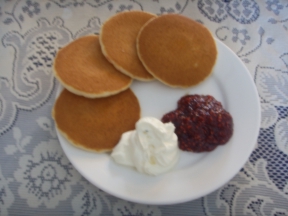
Scotch Pancakes, mmm
The perfect accompaniment to my tea would have been a Scotch pancake. This is not really a pancake as Americans know it, but rather a sweeter, less moist variety that is served room temperature and can be eaten on its own or with jam and clotted cream. (Syrup would be disgusting.)

In the absence of Scotch pancakes (one of the things I could not find locally in NYC, at least not yet, unless I made them myself; I have no need to learn how to make another delicious baked goodie), I satisfied myself with just the tea. Caffeine hit was milder than I expected, 5 out of 10, but I drank the cup slowly over an hour, keeping it warm on my coffee-cup warmer at my desk.

Friday, September 23, 2011

Bai Hao Oolong (caffeinated)

Hm. This tea tested my patience. I brewed it in a teapot, in a tea sachet; at 208F, 180F, and 203F; for three minutes, four minutes. Never did I get the result that Harney & Sons describes: "This is a dark oolong from Taiwan that is similar to Fanciest Formosa Oolong, but it has more body. There are stone fruit aromas without any charcoal masking of the fruit aromas."

I tried to sense what this tea was all about by putting a teaspoon of this tea in the bottom of a mug just poured nearly dry of boiling water; I cupped my hands over the light steam that arose from the warm damp leaves and got a light hint of a green grassy aroma, plus a whisper of some fruit. Maybe this sample was just not that fresh; or perhaps I'm missing something in my tea-making process, though it's hard to imagine that a details-obsessed foodie such as I am, equipped with an instant read thermometer, fine tea sieve, teapot, two mugs, and a source of filtered hot water, could really miss the mark by this wide a margin. The only similarity between my experience and Harney's description was that the tea was indeed dark. Surprisingly dark for such little flavor. A disappointment!

So my first foray into Oolongs has ended with a whimper instead of a bang. Maybe I'll try another assortment sometime and give this tea variety another chance, although at this point I'm tempted to mark Fanciest Formosa Oolong as the only one I like, and just move on.

Next up: black tea breakfast blends, including Scottish and Irish. And I really must create some posts soon about decaf black teas.

Tuesday, September 20, 2011

Fanciest Formosa Oolong (caffeinated)


Fanciest Formosa, ready for its closeup

This was one of Harney & Sons' more expensive Oolongs, costing $2 per cup when bought in the 2 oz size; if you bought it by the pound, you'd pay $1.44 per cup. (Their costliest is currently Top Ti Quan Yin, only available in a 2 oz. tin for $54 -- you'd get 20 to 25 cups of tea from that tin. More than two bucks per cup!)

It would be a shame to compare it to the Pomegranate Oolong I had yesterday. This Fanciest Formosa was in a different category, transcendent. I brewed it at 203F for the first brewing and 208F for the second brewing, both timed for four minutes. The first brewing had it all: a light peach aroma, plus other exquisite fruit notes I couldn't identify, and a beautiful half & half presence of black tea and green tea. It was so good and so delicate at the same time that I devoted at least five minutes to the gradual consumption of this tea. I used my most refined teacup, held it in both hands, and took reverent sips. I can see why this tea is prized.

The second brewing took the peach/fruit aromas down about 80%, but preserved the half-and-half black/green tea balance completely.

I experienced the caffeine hit at a 5 out of 10, but since I got up before dawn today, the tea might really be a 6 for a well-rested person. Today, Tuesday September 20, is an overcast day with a high of 70F and a low forecast at 64F; rain due in the afternoon. A soft weather day, streaked with chilliness when the wind blows; a little dreary. And since I spent my morning in the museum-quality atmosphere of the Upper East Side, "fanciest" appealed to me most among the choices I had, as well as the Oolong's full taste but gentle weight.

"Formosa" is the old Portuguese word for Taiwan. It means "beautiful island."

According to Wikipedia, the name oolong comes from the Chinese for "black dragon tea," 烏龍茶. (Characters are linked to the Google Translate page. Try the "Listen" button to hear the pronunciation, which I hear as Oo loung cha; tones 2, 3, and neutral, respectively.)

Monday, September 19, 2011

Pomegranate Oolong (caffeinated)


I don't normally go for flavored black tea. I suspect the tea itself of being a lesser quality, "tarted up" with some kind of fruity aroma. But I trust Harney & Sons, so I got a sample packet of their Pomegranate Oolong.

Oolong is a funny sort of tea. It's somewhere between green and black, and is usually pretty light in color when brewed, but full of flavor. Great care is taken during the curing process to only partially oxidize the leaves, so what we have here is a natural process halted. H&S likens it to keeping a ripe banana from getting any riper. I suspect that there is an exquisite moment -- a peak in the flavor -- that happens in the oxidation process, and the Oolong is supposed to capture it.

In advertisements for the ballet, or modern dance, you often see a dancer who has been photographed in mid-action, poised in defiance of time. The Oolong aesthete must regard his cup of tea similarly.

I brewed this tea at 203F for three minutes. It didn't seem strong enough so I brewed it two more minutes. The tea was nice, but when I opened the drained teapot to sniff the damp leaves, there was a richness of aroma there -- vanilla, fruit, banana even, among green and brown woodsy notes. I was sorry this didn't carry into the tea more; drinking it was a lesser experience than smelling those brewed leaves! The pomegranate flavor was nice, light enough to let the flavor of the tea come through, but definitely a presence I could recognize and that stayed on my tongue minutes after the final sip.

Caffeine hit was a 6 out of 10.

A pretty good value by the pound: $24. A pound of this tea will make 150 to 160 cups of tea, so each cup costs no more than 16 cents.

Black Tea Blend: Supreme Breakfast (caffeinated)

I realized that the water I'm using is not hot enough! I had to microwave my mug in order to get it to the proper boiling point, 212F. I also wasn't brewing long enough; five minutes is what Harney & Sons recommends. I really enjoyed the aroma from the Supreme Breakfast, although it was a bit smokier than I expected. Milk didn't improve this tea, instead masking the interesting flavors.

Friday September 16: it's a beautiful bright sunny cool Fall day here in New York. I had a shortbread biscuit with this tea and felt glorious; caffeine hit was 9 out of 10, bringing me to the edge of nervous trembles.

I appreciate tea, and I enjoy writing about it, but I know when to step back and allow the words of another, truer believer to carry the day. This is from "Ryan B" at the Harney & Sons website comments:

"Supreme Breakfast is a very full-bodied, well-rounded blend. I find that it requires neither milk nor sugar to be fully enjoyed, though a very conservative amount of either is fine. In general I find Assam teas to be very round, earthy, soft, straightforward and robust, whereas Keemun teas have a thinner, darker, dryer, more rigid yet subtler character, occasionally too astringent for my taste. Supreme Breakfast is an excellent combination of these two teas. The hearty Assam softens the rigidity of the Keemun, removes its slight smokiness and rounds its edges without overwhelming its more subtle flavor, and the piercing quality of the Keemun cuts through the Assam’s simple, almost corpulent body to add a more nuanced taste and a much more interesting finish than either tea has on its own. It’s as if the Keemun is providing mature guidance and structure to the jolly, playful Assam in a shared quest to overwhelm your taste buds with flavor and depth. I highly recommend this tea."

Black Tea Blend: East Frisian (caffeinated)

East Friesland Tea Museum
East Friesland is a region of northwestern Germany that drinks a lot of tea. They have a tea museum, a river called Ems, and earlier this year I dated a fellow named Frisch (a good old Saxon surname), so I wanted to try this tea.

I  brewed this tea using the office coffee machine's hot water spigot, and brewed the tea for four minutes. The result was a beautiful light tea that reminded me of all the good parts of a beer and a pastry and warmed my stomach at the same time.

Thursday, September 15 was a weird day weather-wise in NYC; it started as summer, warm and humid, and then after a brief midday rain shower the temperature plummeted to 60F under dark grey skies and brisk winds. I appreciated this tea, and my emergency office sweater, greatly today.

Fun page about East Friesland and their tea culture (stirring is verboten!): http://www.lowlands-l.net/travels/teetied.php